


If you’ve ever looked up at the winter sky and traced the familiar line of Orion’s Belt, you’ve already seen it. Three stars, bright and evenly spaced—simple, elegant, unmistakable. But simplicity, as you may come to learn on this tour, is often a lie. At the eastern edge of that celestial line burns Alnitak, a star long studied by astronomers… and far longer feared, whispered about, and remembered by those who know the truth behind it.

To begin where scholars are comfortable, we must first establish the mundane truth. Alnitak, cataloged as Zeta Orionis, is not a single star at all—but a trinary star system. It consists of three stars bound together by gravity, locked in an intricate orbital dance that has persisted for millions of years. Its primary component, Alnitak A, is a massive blue supergiant, radiating immense energy—tens of thousands of times more luminous than our Sun. The system as a whole is young by cosmic standards, still burning fiercely, still unstable in ways that intrigue astronomers.
To the scientific community, Alnitak represents stellar formation and evolution, high-energy radiation environments, and the dynamics of multi-star systems. But even among those scientists, there is a quiet acknowledgment—often buried in footnotes—that systems like this are… violent. Chaotic. Unforgiving to the formation of stable worlds. And yet— There was one.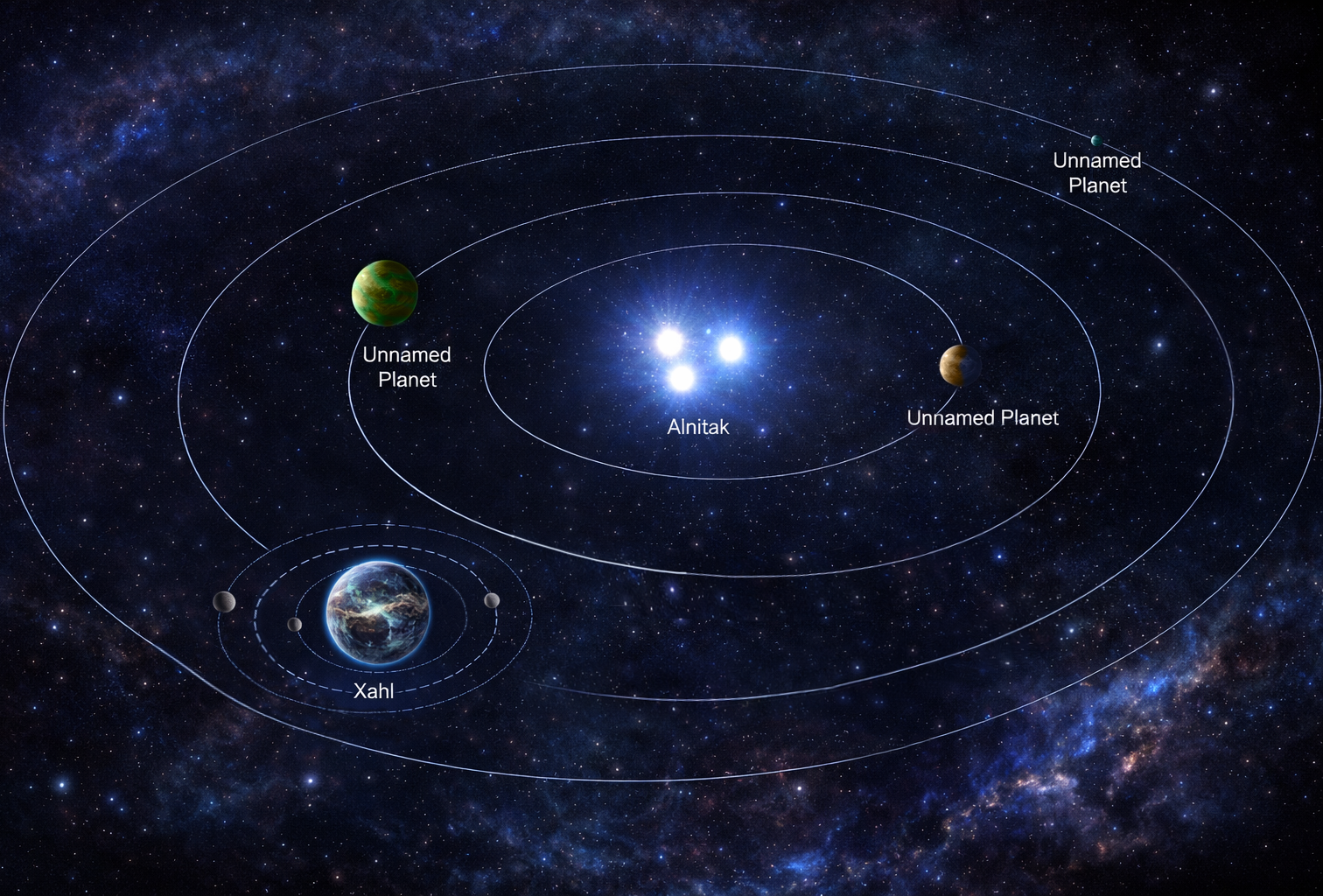
According to the preserved accounts within the The Power, the Portal, and the Path, Alnitak was not merely a distant star system. It was once home. Orbiting within its complex gravitational influence lay a world called Xahl, inhabited by a race known as the Xahl’thari—a people of immense magical aptitude, patience, and restraint.
Unlike many civilizations that rise through conquest or technology, the Xahl’thari cultivated Magic as a fundamental force, shaping their world not through domination, but through understanding. Their cities were said to exist in layered states—partially present, partially hidden—woven between reality and something deeper. Their structures did not decay. Their energy did not exhaust. Their people did not rush. They endured. Until the Gor’tier came. The Gor’tier—giant, expansionist, and insatiable—arrived without warning. They did not negotiate. They did not announce themselves. They harvested. Planets were not homes to them—they were resources. Civilizations were not neighbors—they were obstacles. And Xahl, despite its power, was not spared. But the Xahl’thari did something unexpected. They vanished. Rather than fight a losing war, they retreated—using Magic not to strike back, but to hide. Entire populations withdrew to hidden refuges, concealed across their system’s moons, allowing the Gor’tier to believe they had succeeded in total annihilation. It was not defeat. It was patience weaponized. And when the Gor’tier finally left Xahl—having stripped it of its resources—the Xahl’thari returned to a broken world. It was then they made a decision that would change the fate of multiple worlds—including our own.“Seeing what the Gor’tier had wrought, the Xahl’thari vowed to put an end to their race so no other civilizations would suffer such a tragedy. Using any resources they could scrounge, combined with immense amounts of Magic, they created a vast ship they called Arkken’Arak, which could not only carry nearly the entire remaining Xahl’thari populace but also contained a tremendous weapon - the first weapon the Xahl’thari had ever built."
For a people who had never built weapons, the creation of Arkken’Arak marked a turning point. It was not merely a ship. It was a promise of vengeance. Constructed from the remnants of their civilization and powered by immense Magical forces, Arkken’Arak carried nearly the entire Xahl’thari population—and at its heart, something unprecedented: A weapon. The first they had ever made. And the last they would ever need.
Following the trail of Gor’tier destruction, the Xahl’thari left Alnitak behind, traveling across the void to what they would later call the Ha’losathar system—our solar system. It was here, their campaign unfolded. Shal’noth, a destroyed world between Mal’dek (Mars) and Juol (Jupiter) was shattered completely. Mal’dek, which still held a sizeable population of Gor’tier, was nearly obliterated before Arkken’Arak’ system failed. Unable to initiate repairs, they arrived at Dgh’em (Earth). But what they found here was not what they expected. The Gor’tier had settled. They had grown complacent. They had become… peaceful. And yet, the Xahl’thari did not trust this change. They chose to act.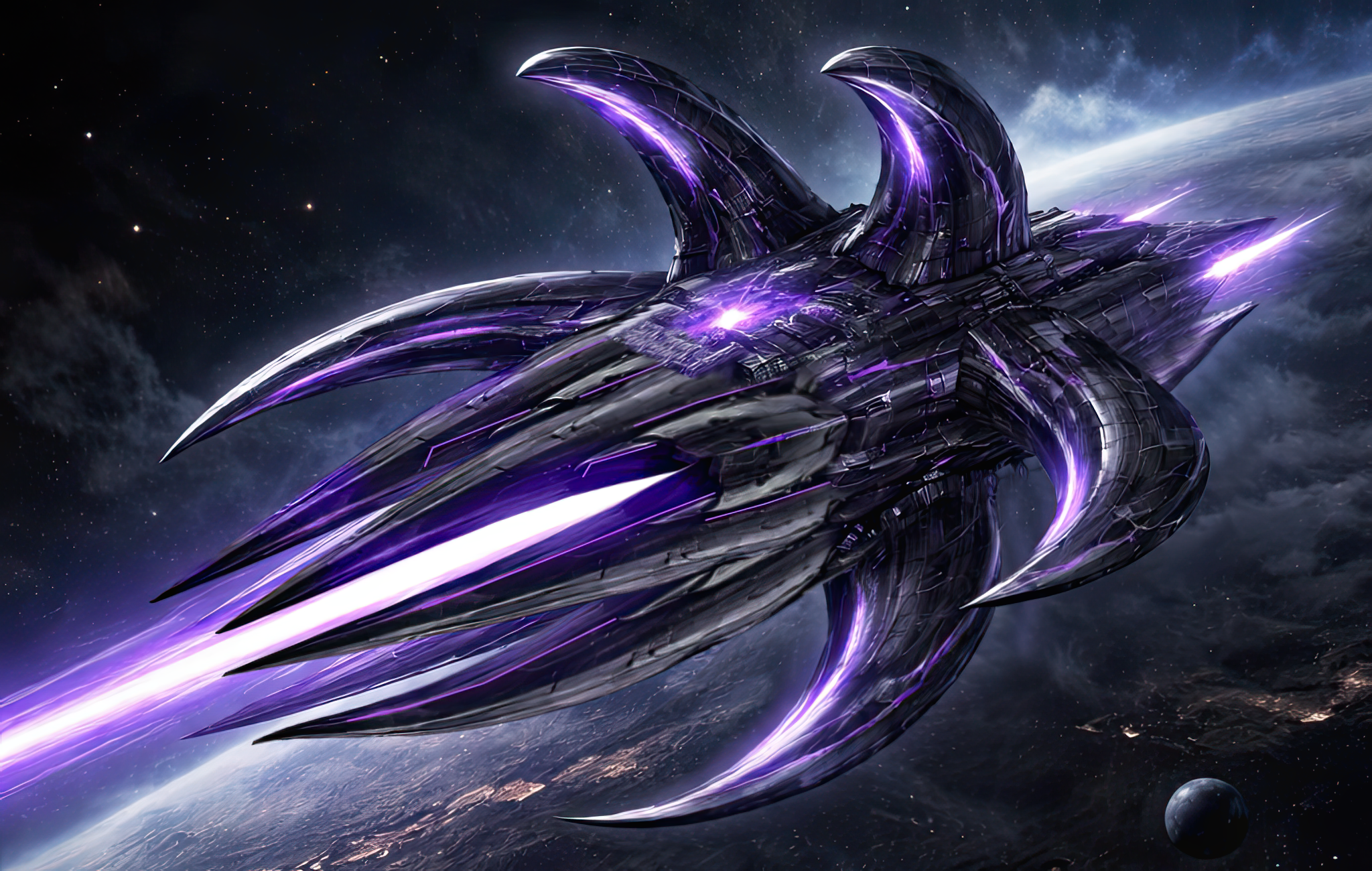
“Although incapable of firing their weapon, the Xahl’thari leaders concluded it would have been too great a loss to destroy such a beautiful planet had they been able to. The Gor’tier, however, could not be left to their own devices; the chance that they might someday return to their conquering ways was too great a risk. So it was that the greatest among the Xahl’thari came together and, using every ounce of their Magical abilities, forged seven weapons of immense power, each of which represented a different aspect of Magic."
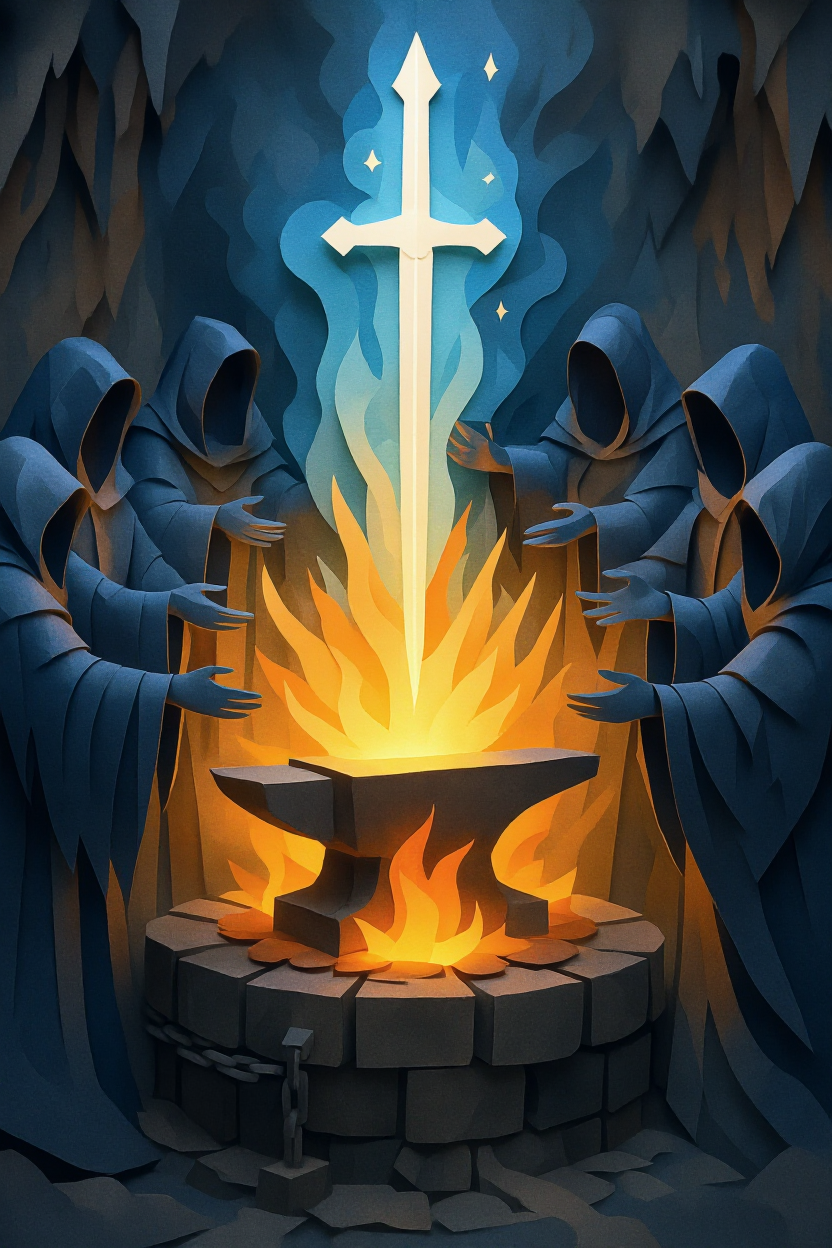
Unable to rely on their failing superweapon, the Xahl’thari forged seven magical artifacts, each representing a different aspect of Magic itself. These were not tools. They were principles made manifest. Through these weapons, they waged war upon the Gor’tier—ending their dominion and reshaping the world in the process. The consequences of that war are still visible today: The Moon, formed from the wreckage of a colossal Gor’tier construct and celestial debris from our two ruined moons, and the restructuring of Earth’s surface and climate.
“In the future, some of our race will change our name to the Dghem’oni. It is a word that slowly evolves into Human through many language transitions.”
The Xahl’thari, stranded on Earth, adapted. They changed. Their language evolved. Their identity softened. And over time, they became something… familiar. When you look up at Alnitak, you are not just looking at a distant star system. You are looking at a place your ancestors once called home. Astronomers may see energy, radiation, and stellar motion, but those who know the deeper truth see something else: A system that once nurtured Magic so potent it could reshape reality… and a people who carried that power across the stars. So the next time you find Orion’s Belt, let your gaze linger on the leftmost star. Not because it is the brightest. Not because it is the most studied. But because it is the one that remembers.
And perhaps—In some quiet, imperceptible way—It remembers you.